

Remember scrolling to Google one random morning in September and finding tiny popcorn kernels running for their lives? Yeah, that happened. The Popcorn Google Doodle, officially titled “Celebrating Popcorn,” took over search homepages worldwide and turned into one of the most talked-about interactive experiences Google has ever shipped. If you missed it live, or you just want to understand why your coworkers kept saying “buttery demise” for a week straight, this guide walks you through everything — the game mechanics, the history behind it, and honestly some stuff competitor articles barely touched on.
Let’s get into it.
What Exactly Is the Popcorn Google Doodle?
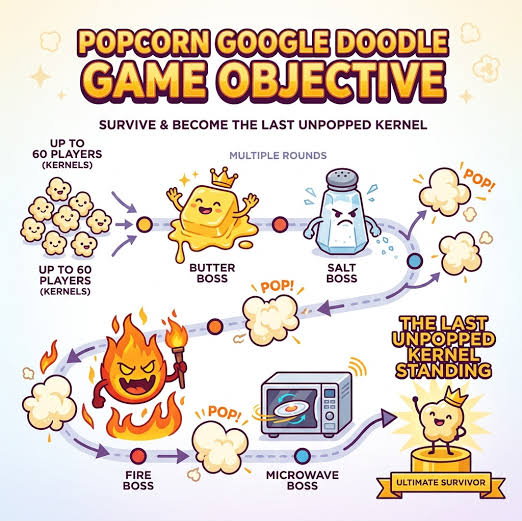
The Popcorn Google Doodle is a multiplayer battle royale game where you control a single popcorn kernel trying to survive against up to 60 other kernels and a rotating cast of dangerous bosses. It launched on September 25, 2024, and it wasn’t just cute animation — it was a fully playable, real-time game embedded right into the search engine’s homepage.
Here’s the quick rundown before we go deeper:
- Genre: Multiplayer battle royale (technically more PvE than PvP, since you’re mostly dodging bosses, not attacking other players)
- Player count: Up to 60, sometimes reported as 61, simultaneous players
- Modes: Solo or Squad (three-player teams)
- Controls: Arrow keys or WASD to move, spacebar for your special ability
- Where to play now: The Google Doodle Archive, since it’s no longer live on the homepage
This Doodle set a record for the highest number of simultaneous players in Doodle history, which is honestly kind of wild when you think about how far these little homepage animations have come since the 90s.
The Real Story Behind the Popcorn Doodle
So why popcorn, and why this particular date? The Popcorn Google Doodle commemorates the day the Guinness World Record for the largest popcorn machine was awarded. That record-breaking machine, which stood over 25 feet tall, 11 feet wide, and 9 feet deep, was awarded in Thailand on September 25, 2020. Google picked the exact four-year anniversary to launch the game, which is a nice little detail a lot of people miss.
But popcorn’s story goes back way further than one giant machine in Thailand. The origins of popcorn trace back to ancient Mesoamerican civilizations, where kernels weren’t just food — they were actually used in ceremonial garb and decoration, which is kind of fascinating if you think about it. Fast forward a few centuries and popcorn became a genuine American staple by the 1800s, sometimes even eaten as a breakfast item mixed with milk (imagine explaining that one to your cereal-loving kid today). The first dedicated popcorn maker showed up in the 1890s, and that’s really when popcorn as we know it started to take shape.
Today Americans consume roughly 14 billion quarts of popcorn per year, which works out to about 43 quarts per person according to U.S. Census Bureau data. That’s a genuinely staggering number and it explains why Google figured this snack deserved its own game.
Also Read: OT7 Quanny Age Revealed
Also Read: Mark Singer Gorilla Glue Net Worth
Why Popcorn Specifically? The Doodle Team’s Thinking
The people behind these games, affectionately called Doodlers, apparently spent real time brainstorming weird questions like “what would a popcorn kernel’s biggest fear be?” and “should the attacking kernel have muscles?” That playful, slightly absurd approach is exactly why the final bosses are literally Butter, Salt, Fire, and a Microwave — the very things that turn a raw kernel into popped corn became your enemies. It’s a clever bit of design, honestly.
The Doodle also leaned into popcorn’s global appeal. Different cultures season it in wildly different ways:
- Pipoca in Brazil, sweet or savory depending on region
- Nori-topped popcorn in Japan for that umami kick
- Za’atar popcorn in the Middle East, herby and aromatic
- Maple popcorn in Canada, because of course
This global spread is part of why popcorn works so well as a movie theater companion and late-night snack across basically every culture — it’s flexible in a way most snacks just aren’t.
How to Play: Controls, Modes, and Basics
Getting into the game is pretty painless, which is probably part of why it went viral so fast.
Controls are simple:
- Movement — arrow keys or WASD
- Special ability — spacebar
That’s genuinely it for input. The depth comes from timing and positioning, not complicated combos.
Also Read: Albert Omstead: The Life, Career, and Legacy of a Cobra Kai Crew Member
Also Read: Pedro Paulo Executive Coaching
Game modes break down like this:
- Solo Mode pits you against up to 60 real players in a free-for-all. It’s every kernel for itself, and your individual dodging skill is really all that matters here.
- Squad Mode lets you team up with up to two friends (three total) via an invite link. Squads can revive popped teammates, which adds a genuine strategic layer that solo play just doesn’t have.
Each kernel starts with two hearts. Lose both, and you pop — game over for you, though in Squad mode your teammates might still bring you back.
Meet the Kernels: Playable Characters
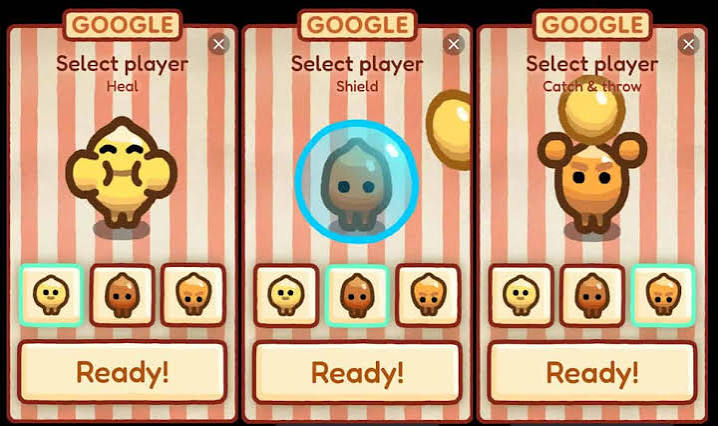
There are three playable kernel types, and picking the right one matters more than you’d think going in.
| Character | Ability | Cooldown | Best Used For |
| Heal | Eats small projectiles to restore health | Fast | Sustained survival, supporting squad members |
| Shield | Creates an invulnerable barrier that reflects projectiles | Long | Protecting yourself or teammates from big hits |
| Catch & Throw | Grabs incoming projectiles and hurls them back at bosses | Medium | Offensive play, requires precise timing |
Catch & Throw is the only kernel with two linked abilities (catch, then throw), which makes it the trickiest to master but also probably the most satisfying when you land a good throw. A balanced Squad usually mixes all three — Heal for staying power, Shield for defense, Catch & Throw for actually dealing damage back.
The Bosses: Who You’re Actually Fighting
Every boss in the Popcorn Google Doodle represents something that literally destroys popcorn kernels in real life, which is a nice bit of irony.
Butter is your first opponent. It slides across the pan leaving trails that pop you on contact, and its main attack is shooting droplets of melted butter outward. Staying near the pan’s edge during its final attack phase tends to be the safer bet.
Salt moves faster and more erratically than Butter, scattering crystal projectiles in dense, unpredictable patterns. Constant movement is basically mandatory here since Salt can vanish from view momentarily before reappearing somewhere dangerous.
Fire heats up sections of the arena into temporary hot zones and fires expanding rings you need to dodge. A lot of experienced players say positioning yourself slightly below and to the right gives you a clearer read on its attack windup.
Microwave (sometimes called Magnetron) is widely considered the hardest boss in the game. It fires a chaotic, multiplying barrage of electrical orbs that split apart and can overwhelm players fast. Staying near the center during its second phase reportedly helps since the projectile beams move slower relative to that position.
Boss → attack pattern → survival strategy is really the loop you need to internalize for each one, and once it clicks, the whole game gets noticeably easier.
Pro Tips for Not Getting Popped
A few things that separate players who survive multiple rounds from the ones who pop in the first ten seconds:
- Position yourself deliberately. Corners feel safe early but turn into death traps once the arena gets crowded.
- Don’t spam your ability. Learn your character’s cooldown and time it for when it actually matters.
- Study projectile timing, especially against Microwave, since its splitting orbs follow a rhythm once you’ve seen it a few times.
- Stay calm. Sixty players and multiple bosses on screen gets chaotic fast, and panicking almost always leads to a bad dodge.
- Communicate in Squad Mode. Calling out “Butter’s coming left!” genuinely helps more than you’d expect.
How the Game Was Actually Built (The Part Most Articles Skip)
Here’s something most coverage of the Popcorn Google Doodle glosses over entirely: the technical challenge of running a 60-player real-time multiplayer game inside a browser, on Google’s homepage, with essentially zero load time expectations from users.
This isn’t a small engineering feat. Real-time multiplayer games typically rely on dedicated netcode to synchronize player positions, boss attack states, and projectile movement across dozens of simultaneous connections without noticeable lag. For a Google Doodle — something meant to load instantly for a global audience with wildly different internet speeds — that’s a genuinely hard constraint to work around. Most browser-based multiplayer experiments accept some tradeoff between player count and responsiveness; supporting up to 60-61 concurrent players while keeping input-to-action latency low enough for a fast-paced dodging game is not trivial.
The Doodle team, which included leads like Jessica Yu, Alyssa Winans, Nate Swinehart, Tom Tabanao, and Jacob Howcroft, worked alongside engineers to pull this off, with sound design handled by Todd Baker and UX program management split between Madeline Belliveau, Kelley Lay, and George Verno. This was a genuinely cross-functional build — artists, engineers, and marketers (Selly Sallah and Caroline Moran) all had to align on something that needed to be charming, technically stable, and playable by literally millions of people at once.
The broader lesson here is that Google Doodles have evolved way past static illustrations. What started as an informal “out of office” message Larry Page and Sergey Brin left when heading to Burning Man back in 1998 has turned into a full creative and engineering discipline inside Google, capable of shipping genuine multiplayer infrastructure for a one-off homepage feature.
Popcorn’s Deeper Cultural Roots (The Other Missing Piece)
Most coverage mentions popcorn’s Mesoamerican origins in a single sentence and moves on. That undersells it a bit.
Archaeological evidence suggests popcorn-like corn varieties were being used in the Americas thousands of years before European contact, and popped corn specifically held ceremonial significance in some Mesoamerican cultures, appearing woven into decorative headdresses and ritual garb rather than just eaten as food. That’s a pretty different relationship with the snack than what we have today, where it’s mostly associated with movie theaters and Tuesday night couch sessions.
By the time popcorn reached widespread American popularity in the 1800s, it had shifted into something closer to what we’d recognize now, including — a bit strangely by modern standards — being eaten with milk as a breakfast food in some households. The invention of dedicated popcorn-making machines in the 1890s is really the turning point where popcorn transitions from a homemade treat into something sold commercially, eventually becoming the movie theater staple everyone associates it with today.
The global flavor variations mentioned earlier (pipoca, za’atar popcorn, nori popcorn, maple popcorn) aren’t just fun trivia either — they reflect how a single, simple food adapts to completely different culinary traditions while keeping its core identity intact. That adaptability is arguably the real reason Google picked popcorn for a game meant to have global, cross-cultural appeal in the first place.
Where to Play the Popcorn Google Doodle Now
The game is no longer live on Google’s homepage, but it hasn’t disappeared. You can still find and play it through the Google Doodle Archive, where Google keeps essentially every past Doodle accessible indefinitely. Searching “Celebrating Popcorn Doodle” will also point you directly to it. A handful of third-party sites have mirrored the game too, so it remains playable well beyond its original launch window.
Frequently Asked Questions
What was the Popcorn Google Doodle celebrating? It celebrated the anniversary of the Guinness World Record for the largest popcorn machine, awarded in Thailand on September 25, 2020. It also honored popcorn’s long history and its diverse cultural significance around the world, from ancient rituals to modern movie snacks.
Can I still play the Popcorn Google Doodle? Yes. Even though it’s off the homepage now, the game lives permanently in the Google Doodle Archive. A quick search for “Celebrating Popcorn Doodle” gets you there directly, and you can still play Solo or Squad mode anytime.
How many players can join a single match? Up to 60, with some reports citing 61 simultaneous players. This made it the Doodle with the highest concurrent player count in Google’s history, a genuinely notable technical achievement for a browser-based game.
What are the three playable characters? Heal, Shield, and Catch & Throw. Heal restores health by consuming small projectiles, Shield creates a reflecting barrier, and Catch & Throw lets you grab and hurl projectiles back at bosses for offense.