
If you’ve been searching for a focused, no-noise space where real coding conversations happen, programgeeks social media might already be on your radar. The mainstream feeds — built to keep you scrolling — rarely reward serious learning. So when a platform promises to put developers, students, and tech creators in the same room without all the distraction, people pay attention.
This guide covers everything you need to know: what ProgramGeeks Social actually is, who it’s genuinely built for, how to verify it before you trust it with your time or data, and how to get real career value out of it. We’ll also go deeper than any competitor article has gone — specifically on the two things most guides skip: how to independently verify a niche platform, and what a real onboarding journey looks like week by week.
What Is ProgramGeeks Social Media?
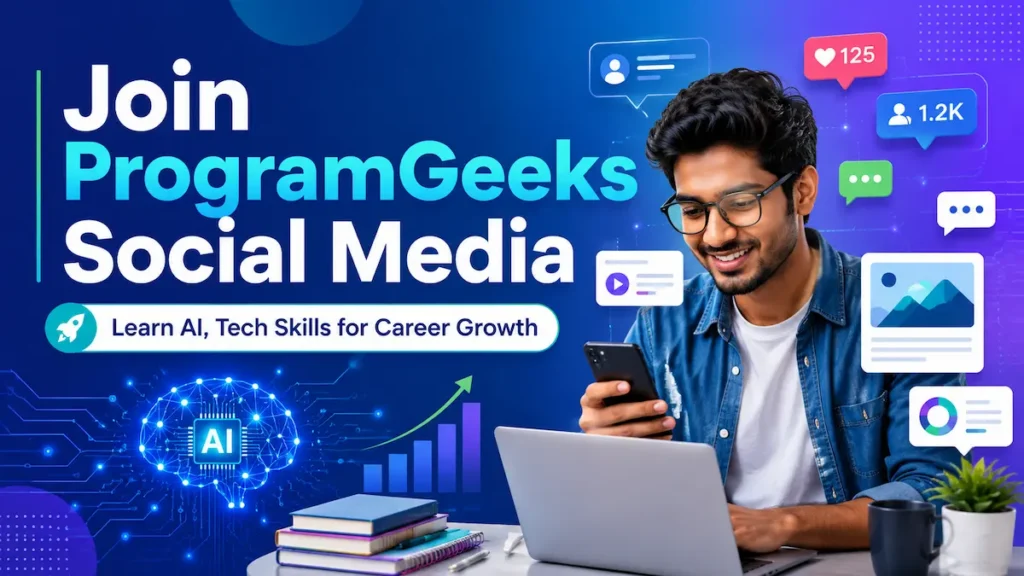
ProgramGeeks Social is described across multiple sources as a community-driven platform built specifically for developers, programmers, tech enthusiasts, students, and digital creators. Unlike LinkedIn — which mixes job posts, corporate announcements, and motivational quotes — ProgramGeeks Social positions itself as a tech-focused platform where every conversation circles back to coding, artificial intelligence, cybersecurity, web development, and digital tools.
The core idea is pretty straightforward. Instead of hunting across Reddit threads, Discord servers, and scattered YouTube comments for answers to your actual problems, you get one place. One feed. One community focused on knowledge sharing and continuous learning.
At its core, ProgramGeeks Social focuses on three things: closing the gap between learning and professional growth, enabling project sharing and feedback, and connecting members with industry mentors and experts who’ve already walked the road you’re on.
It’s worth being upfront, though. Compared to established names like GitHub, Stack Overflow, or LinkedIn, publicly verified information about the platform is still limited. That’s not automatically a red flag — every community starts somewhere. But it does mean you should evaluate it carefully, and we’ll show you exactly how to do that later in this guide.
Why Developers Are Actively Searching for ProgramGeeks Social
The rise in search interest around programgeeks social media reflects a broader shift in how developers want to spend their time online. Platform fatigue is real. Developers have grown tired of algorithm-driven feeds that bury technical content under viral posts and brand promotions.
What’s driving people toward niche tech communities like this one comes down to a few things:
AI and automation changed what developers need to discuss. Post-2023, conversations shifted. Basic syntax questions now get answered by AI assistants in seconds. What developers actually want to discuss is system architecture, machine learning workflows, prompt engineering, AI tooling, and software scalability — and those conversations need a focused home.
Smaller communities deliver stronger signal. In a large platform, a valuable thread disappears in hours. In a niche developer community, relevant content stays visible, moderation is tighter, and the ratio of useful-to-noise is much better.
Digital portfolios matter more than ever. Recruiters actively scan social platforms for talent, and developers know it. A well-maintained profile on a tech-focused platform — showing real projects, contributions, and technical discussions — builds credibility in ways a static resume simply can’t.
You may also like to read BigXthaPlug Height Revealed
Discover more about: Hunxho Age Revealed
You may also like to know about Uploadblog Homepage Walkthrough
Core Features of ProgramGeeks Social Media
Based on how the platform is consistently described, here’s what you can generally expect to find. Always verify current features on the platform directly, since things do change.
| Feature | What It Does | Why It Matters |
| User Profiles / Digital Portfolio | Showcase skills, projects, interests | Signals expertise to peers and recruiters |
| Topic-Based Groups | Communities around AI, cybersecurity, freelancing, SEO | Faster discovery of relevant content |
| Technical Discussions | Threaded conversations on coding, tools, software | Peer-driven problem solving |
| Project Sharing | Post apps, repos, experiments | Receive honest feedback, build visibility |
| Industry Mentor Access | Connect with experienced professionals | Accelerates career development and technical confidence |
| Coding Challenges | Engagement mechanics keeping members active | Builds skills while maintaining community energy |
| Job Listings / Career Resources | Curated postings targeting tech professionals | Turns networking into actual opportunities |
Who Should Actually Use ProgramGeeks Social Media?
Honestly, not everyone needs another platform. But if any of the following describes you, it’s worth exploring:
Students and self-learners building programming fundamentals who want a place to ask questions without judgement. Beginner and intermediate developers looking for honest feedback on their code and projects. Freelancers who want to demonstrate expertise and build an audience around genuine technical knowledge. Digital creators — tech bloggers, educators, and YouTubers — who want to share tutorials and grow visibility in a relevant community. AI and cybersecurity learners following a field that changes literally every month. Startup founders and product teams who want to test ideas and stay current with software development ecosystem trends.
If your primary goal is passive entertainment, mainstream platforms will serve you better. ProgramGeeks Social is built for people who want productive social media use.
How ProgramGeeks Social Supports Career Development
Industry mentors accelerate member career development and technical confidence — and that’s one of the clearest value propositions this platform advertises. Access to experienced professionals who’ve already navigated the complexities of the tech industry is genuinely hard to find in a structured way.
Career development on ProgramGeeks Social reportedly includes a few distinct resources:
Interactive webinars hosted by professionals actively working in their fields. A library of digital resources covering various programming languages, frameworks, and platforms. Peer-to-peer mentoring where developers at different career stages swap insights and experience. Hand-picked job postings curated specifically for tech-savvy professionals.
And beyond the formal resources, there’s something more subtle happening. When you participate consistently in a coding community — asking good questions, sharing honest project updates, giving feedback to others — you’re doing personal branding without calling it that. Recruiters notice. Collaborators notice. Doors open that a traditional job application never would have unlocked.
Discover more about: GlaadVoice com Explained
You may also like to know about Kathleen Nimmo Lynch
How ProgramGeeks Social Compares to Established Platforms
ProgramGeeks Social positions itself against general social media — against the distraction, the noise, the entertainment-first design. That’s its defining value proposition. But how does it stack up against the tools developers already rely on?
The honest answer is: it doesn’t replace them. It complements them.
GitHub is where code lives. Stack Overflow is where you go when something breaks and you need a precise answer fast. LinkedIn is your professional resume, visible to recruiters globally. Discord is real-time, voice-and-text community interaction. Reddit is broad community opinion and trend discussion.
ProgramGeeks Social sits in a different lane — a combination of learning, community discussion, portfolio visibility, and programmer networking that no single platform covers well on its own. Used alongside your existing toolkit, a focused niche tech community adds genuine value. Used in isolation, its smaller audience size is a real limitation to keep in mind.
How to Verify ProgramGeeks Social Before You Trust It
This is the section most guides skip entirely. Competitors acknowledge that public information on the platform is “limited” — and then move on. We’re not going to do that, because verification is actually the most important step before joining any niche community.
Here’s a practical framework for evaluating ProgramGeeks Social — or honestly, any emerging tech-focused platform:
Start with policy transparency. A trustworthy platform makes its privacy policy, terms of service, and community guidelines easy to find and written in plain language. Vague or missing legal pages are a genuine warning sign. Look specifically for: how user data is stored, whether third-party tracking exists, and how content is moderated.
Check domain and platform history. Tools like Whois or web.archive.org let you see how old a domain is and how the site has evolved. A platform with years of consistent content is generally more credible than one that appeared recently with polished but thin pages.
Audit the community activity itself. Are the discussions recent? Are they genuine — meaning varied, sometimes messy, asking real questions — or do they feel templated and promotional? Real developer communities have a certain roughness to them. Users disagree. Threads go off-topic. That’s actually a healthy sign.
Look for third-party mentions. Search for the platform name on Reddit, GitHub discussions, tech forums, and review sites. What are actual users saying outside the platform’s own pages? Authentic community sentiment is hard to fake at scale.
Test the security basics. Does the site use HTTPS? Is two-factor authentication available? Are there clear reporting tools for spam and abuse? These aren’t optional features — they’re baseline signals of a platform that takes community moderation seriously.
Green flags to look for: Specific, accessible privacy policy. Active moderation. Recent, genuine discussions. Clear support and contact channels. Reasonable, honest claims about what the platform does.
Red flags that should give you pause: No visible privacy policy. No way to report abuse. Feeds that look mostly like bot activity or promotional content. Promises of guaranteed income or job placement. Requests for excessive personal information at signup.
Run any new community through this lens before you upload projects, share professional details, or invest significant time. The habit will serve you well beyond this one platform.
Your First 4 Weeks: A Real Onboarding Journey
The second thing every competitor article fails to deliver is a concrete, stage-based picture of what getting value from this platform actually looks like. Here’s a realistic week-by-week roadmap.
Week 1 — Build your foundation. Create a complete profile. Add your real name or brand, a short bio that mentions your focus areas (e.g., “front-end developer interested in AI tooling and React”), your skills, and links to any existing work — GitHub repos, a personal site, a blog. Join two or three topic-based groups that match where you are right now, not where you aspire to be. Aspiration groups get overwhelming fast.
Week 2 — Consume before you contribute. Spend this week reading. Follow active threads. Pay attention to the questions that get the most thoughtful responses — those reveal what the community cares about. Save useful posts. Notice which members consistently give high-quality answers. Those are the people worth following and eventually reaching out to.
Week 3 — Make your first real contributions. Post a question about something you’re genuinely stuck on. Share a small project update — doesn’t have to be finished, doesn’t have to be impressive. Comment on three to five threads with an actual opinion or piece of information, not just “great post.” This is how you start building a presence and getting onto people’s radar.
Week 4 — Start engaging with mentors. By week four, you should have a sense of who the industry mentors and experts are in your areas of interest. Reach out with a specific, respectful message — not “can you mentor me” but “I read your post on X and had a follow-up question about Y.” Specificity gets responses. Vague asks get ignored.
By the end of month one, you should have at least one meaningful connection, one piece of feedback on your work, and a clearer picture of whether the community is genuinely active in your technical area. If those three things haven’t happened, it may not be the right community for your goals — and that’s useful information too.
Safety and Privacy Best Practices for Tech Platform Users
Digital portfolio and profile build credibility — but only share what’s appropriate for a public professional space. Some things should never go on any community platform:
Never post API keys, passwords, or authentication tokens — even accidentally in code screenshots. Never share confidential client work or proprietary code without explicit permission. Be cautious about posting your exact location, phone number, or personal email publicly. Verify links before clicking, especially in direct messages from accounts you don’t recognize. Download files only from users with established, verifiable histories in the community.
Platform transparency and privacy policy aren’t just legal formalities — they’re your clearest window into how a platform actually treats its users. Read them before you sign up, not after.
Is ProgramGeeks Social Media Worth Your Time in 2026?
For developers, students, freelancers, and creators who are genuinely interested in programming, AI, cybersecurity, and the broader software development ecosystem — yes, a focused community is worth exploring. The case for it is real: less algorithmic noise, more relevant content, better networking quality, and the kind of peer-driven learning that formal courses rarely deliver.
But “worth exploring” and “worth fully committing to” are different things. ProgramGeeks Social is an emerging platform in a category that’s growing fast. Its long-term value depends entirely on community moderation quality, genuine user engagement, and how well it handles the challenges every niche platform eventually faces — spam, misinformation, user retention, and platform sustainability.
Use the verification framework in this guide before you invest heavily. Participate consistently if the community checks out. Treat it as a complement to your existing toolkit — GitHub, Stack Overflow, LinkedIn — not a replacement for them. And keep your expectations grounded in what a niche community can realistically deliver right now, with room to grow into something bigger.
Frequently Asked Questions
Is ProgramGeeks Social Media free to use? Publicly verified pricing details are limited. Most niche developer communities offer free basic access with optional premium features. You should confirm current membership options directly through official platform pages before signing up.
How is ProgramGeeks Social different from GitHub or Stack Overflow? GitHub focuses on code hosting and version control. Stack Overflow handles specific technical Q&A. ProgramGeeks Social is designed for broader community engagement — discussions, networking, project sharing, and mentorship — making them complementary rather than competing tools.
Can ProgramGeeks Social actually help my career? Active participation in a focused coding community can build your digital portfolio, open mentorship connections, and improve visibility with recruiters. Results depend on how consistently you contribute and whether the community is genuinely active in your technical area.
What should I check before joining any niche tech platform? Always review the privacy policy, check community moderation standards, audit the authenticity of user discussions, and look for third-party mentions on Reddit or tech forums. Transparent platforms that make policies easy to find are generally more trustworthy.