

Ever had one of those days where you just need two minutes to yourself, but downloading an app feels like way too much effort? That’s basically the whole pitch for google block breaker — a free, no-install brick-smashing game that lives right inside your Google search results. You type a few words, hit enter, and suddenly you’re bouncing a ball around like it’s 1976 again. In this guide we’re going to break down (pun kind of intended) everything about this game: what it is, how it plays, where it came from, and honestly, how to get good enough at it that your coworkers start asking for tips.
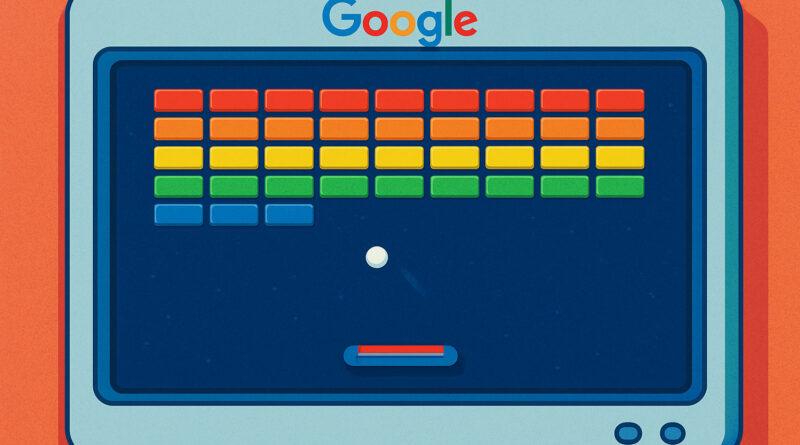
What Exactly Is Google Block Breaker?
Google block breaker is a free, browser-based paddle-and-ball game that appears as an interactive card directly in Google’s search results — no app store, no login, no download required. It’s part of a small family of playable Easter eggs Google has tucked into its search engine over the years, and unlike a holiday Doodle that disappears after a week, this one has more or less become a permanent fixture.
If you’ve ever played Atari Breakout, you already understand the basic idea. Google took that same “bounce a ball, smash some blocks” formula and gave it a fresh coat of paint — brighter colors, smoother animation, and controls that actually feel good whether you’re on a laptop or thumbing around on your phone. It’s not trying to reinvent anything. It’s just trying to be there when you need a quick mental reset, which, honestly, is kind of refreshing in a gaming landscape obsessed with battle passes and microtransactions.
A Quick Snapshot
- What it is: A free arcade-style paddle game inspired by Atari Breakout
- Where to find it: Search “Block Breaker” on Google and click Play
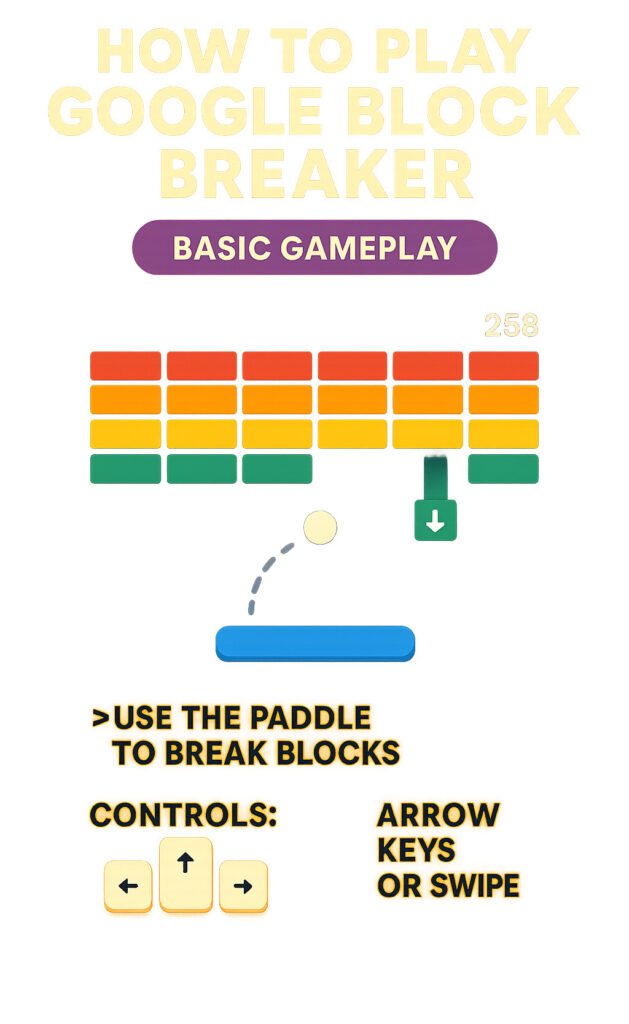
- Controls: Arrow keys or mouse on desktop; swipe/tap on mobile
- Objective: Bounce the ball to destroy colored blocks before it falls past your paddle
- Best for: Short breaks, waiting rooms, or that dead five minutes before your next meeting starts
Where Did Google Block Breaker Actually Come From?
This is where it gets kind of interesting, honestly. Atari Breakout → inspired → Google Block Breaker, and Atari’s original 1976 cabinet has a backstory most people never hear about. Steve Jobs landed the contract to build Breakout for Atari, but he wasn’t the one doing the actual engineering — that job fell to his friend Steve Wozniak.
Here’s the part that really gets me: Steve Wozniak → engineered → the original Breakout hardware, and the chip-reduction tricks he used to make that game run efficiently later fed directly into the design of the Apple II’s color graphics system. So there’s a legitimate straight line between a quarter-eating arcade cabinet and the machine that helped kickstart the personal computer boom. Wild, right? Every time you nudge that little digital paddle in google block breaker, you’re technically brushing up against a small slice of computing history.
Google, being Google, decided to fold this legacy into its search product as one of many playable Easter eggs — following on the success of an earlier Atari Breakout tribute the company launched back in 2013.
How to Access and Play Google Block Breaker (Step-by-Step)
To play google block breaker, search “Block Breaker” on Google.com, then click the Play button on the interactive card that appears near the top of your results. That’s really it — no account creation, no waiting for anything to buffer.
Here’s the full walkthrough if you want it spelled out:
- Open your browser (or the Google app on mobile) and go to Google.com
- Type “Block Breaker” into the search bar — no quotation marks needed
- Look for the colorful game card, usually sitting right near the top of the results
- Tap or click Play
- Start bouncing — the ball’s ready to go the second the game loads
One thing worth mentioning: this feature can be a little inconsistent depending on where you’re searching from. If it doesn’t pop up right away, try your local language — Spanish speakers, for example, have had better luck searching “Rompebloques.” And if Google’s main search just isn’t cooperating for whatever reason, the unofficial elgooG mirror site (elgoog.im) preserves this and a bunch of other Google Easter eggs, so it’s a decent backup plan.
Control Schemes That Actually Work
On desktop, you’ve got a couple options. Arrow keys give you the most precise paddle movement, or you can just drag your mouse left and right if that feels more natural. Press spacebar or click anywhere to launch the ball. Mobile players swipe to move the paddle and tap to fire — some people prefer holding and dragging for smoother, continuous control, and that works fine too.
A small but genuinely useful detail: the game automatically pauses when you switch browser tabs, so if an urgent Slack message pulls you away mid-game, you won’t lose your combo streak. Come back, and you’re right where you left off.
You may also like to read: Rizz Monkey Explained
You may also like to read: Ari Fletcher Age
Core Mechanics, Block Types, and Power-Ups
The physics in google block breaker are simple to learn but surprisingly deep once you start paying attention. Hit the ball dead-center with your paddle and it flies straight up — great for precision, not so great for reaching tricky corners. Paddle edge shots → create → angled ball trajectories, which is really the key mechanic experienced players lean on to clear stubborn sections of the board.
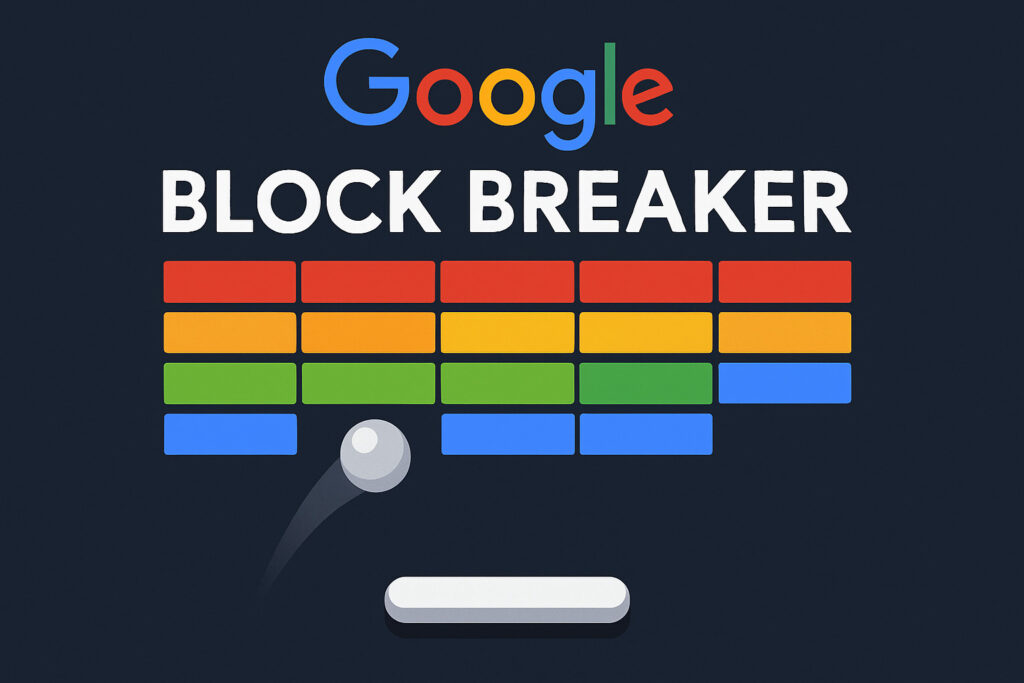
You’ll run into a few different block categories as you play:
- Standard blocks — pop with a single hit
- Reinforced blocks — need multiple hits, usually guarding the good stuff
- Indestructible blocks — can’t be destroyed at all; they’re there to make you think about angles differently
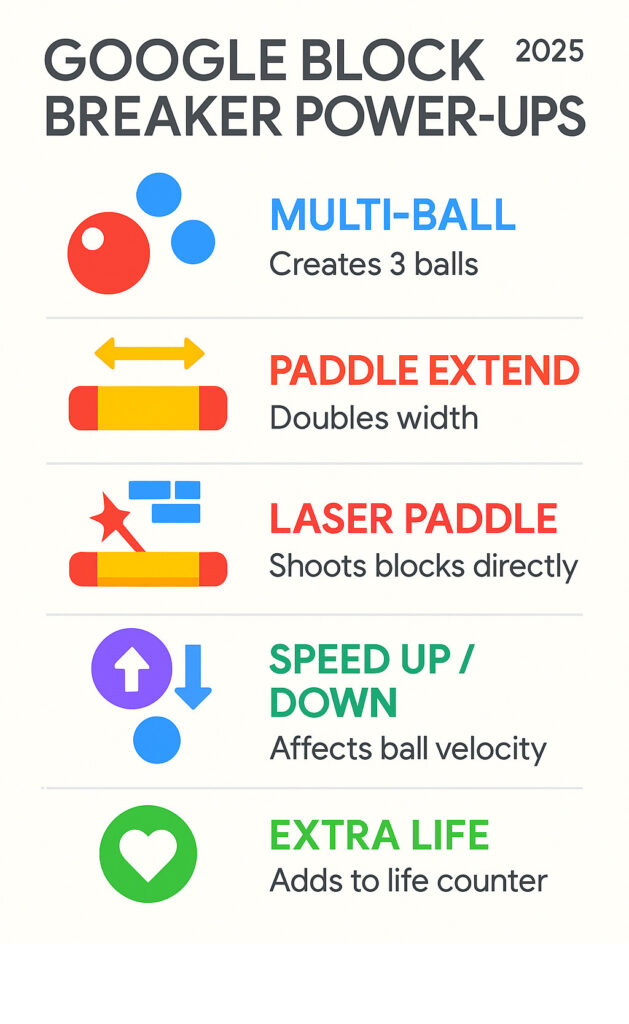
Then there’s the power-up system, which is honestly where a lot of the game’s personality shows up. Power-ups → drop from → destroyed blocks, and grabbing one can flip the whole rhythm of a level:
| Power-Up | Effect |
|---|---|
| Multi-Ball | Splits your single ball into three |
| Paddle Extend | Doubles paddle width for easier catches |
| Laser Paddle | Lets you shoot blocks directly |
| Speed Up/Down | Alters ball velocity |
| Extra Life | Adds to your life counter |
With over 100 levels available, the block patterns get noticeably trickier as you go — simple grids early on, then increasingly deliberate layouts that basically demand you use gaps and angles strategically instead of just spamming shots.
Scoring, Lives, and Why There’s No Save Feature
Standard blocks are worth 10 points each, and chaining destructions quickly triggers combo multipliers that boost your score dramatically. Finishing a level tacks on a 50-point bonus, which is a nice incentive to actually clear the whole board instead of rushing past.
You start with three lives, and losing all of them ends your run. There’s genuine tension built into that simplicity — no shields, no extra continues, just you and the paddle. And yeah, a lot of players ask about this: google block breaker does not save your progress between sessions. Close the tab, and you’re starting over next time. That’s not a bug, it’s basically a design choice that keeps each play session feeling like its own little complete arcade run, rather than something you’re grinding away at for weeks.
Strategies to Boost Your Score
Want to actually get good at this thing instead of just button-mashing? A few tactics genuinely make a difference:
- Use paddle edges deliberately. Edge hits create angled shots that can slice through tight formations way better than dead-center hits.
- Hunt for gaps. Once you punch a hole through a block wall, a single well-placed shot can clear whole back rows you’d otherwise need dozens of bounces to reach.
- Time your power-ups. Save paddle-extend for chaotic multi-ball moments rather than using it the second it drops.
- Watch the lower third of the screen. Your peripheral vision handles the upper blocks fine — keeping your eyes low keeps paddle control smoother and less panicky.
- Practice level replay. Once you clear a stage, you can revisit it in the same session to build muscle memory for trickier layouts.
None of this is rocket science, but it’s the kind of stuff that separates someone randomly flailing at the paddle from someone quietly racking up a stupidly high score during their lunch break.
You may also like to read: Peter Orszag Bald
You may also like to read: Christian Stracke Net Worth
What Competitors Miss: Access Troubleshooting and Genre Landscape
Most write-ups on this topic gloss over two things that actually matter a lot to real users, so let’s fix that.
Why Doesn’t the Game Always Show Up in Search?
This trips people up more than you’d think. The interactive card that triggers google block breaker isn’t guaranteed to appear on every search — it depends on a mix of factors including your region, browser type, JavaScript settings, and even whether you’re using a VPN. Some corporate or school networks also block interactive search features entirely as part of broader content filtering, which explains why the game might work fine on your phone but refuse to load on your work laptop. If it’s not showing up, try clearing your cache, switching browsers, or disabling any aggressive ad-blocker extensions — those sometimes strip out the interactive elements Google needs to render the card.
How Does It Compare to Other Brick-Breakers Out There?
The article world tends to compare this game only to the original Atari Breakout, but that’s really just one data point. There’s a whole lineage of brick-breaker games worth knowing about — Arkanoid added spaceship theming and a much wider variety of power-ups back in the 80s, and there are countless mobile brick-breaker apps today that, frankly, bury the core gameplay under ads and pop-up purchase prompts. Google’s version sits in a nice middle ground: more depth than the 1976 original, but none of the monetization clutter that weighs down most modern mobile alternatives. It’s also worth noting that accessibility features like high-contrast mode (available through your browser settings) and keyboard-only play make it more approachable than most competitors, even if Google hasn’t marketed that angle much.
Why This Game Has Stuck Around So Long
There’s something almost meditative about it, honestly. Block-breaking games trigger a satisfying loop of immediate reward and gradual progress — every block pop gives you a tiny hit of gratification, and clearing a level feels like a genuine accomplishment even though, realistically, nothing’s actually at stake. The short session length is a big part of the appeal too. You don’t need an hour, you need three minutes, and google block breaker respects that.
It also happens to be one of those rare activities that’s fun and mildly good for you — the constant tracking of ball trajectory and paddle positioning does actually sharpen hand-eye coordination a bit over time. Not that anyone’s playing it for the cognitive benefits, but hey, it’s a nice bonus.
Frequently Asked Questions
Is google block breaker completely free to play? Yes, it’s 100% free with no hidden costs, subscriptions, or in-app purchases. It works across Windows, Mac, Linux, iOS, and Android devices, adapting its controls automatically whether you’re using a keyboard, mouse, or touchscreen.
Can I save my progress or come back to a level later? No, google block breaker doesn’t save progress between sessions — closing your browser resets everything. However, within a single play session you can replay any level you’ve already cleared through the in-game level menu.
Why can’t I find the game when I search for it? This usually comes down to region, language, or browser settings. Try searching in your local language (like “Rompebloques” for Spanish), disable ad-blockers, or clear your browser cache. The elgooG mirror site is a solid backup option too.
How do I share my high score with friends? After clearing a level, a share button appears letting you post your score and completed level to social platforms. There’s no formal leaderboard, but this feature has sparked plenty of informal office competitions.