

If you’ve been scrolling through tech forums lately, chances are you’ve bumped into the name feedbuzzard tech more than once. And honestly, that’s not surprising — the platform has been quietly building a reputation as both a content hub for curious readers and an advertising tool for brands trying to squeeze more value out of every marketing dollar. But what is it, really, and is it worth your attention (or your ad budget)? This guide breaks it all down, no fluff, just the stuff that actually matters.
We’ll walk through what the platform publishes, how its AI-powered customization works, what makes its advertising arm different from a typical ad network, and — this is the part most articles skip — how it handles your data and whether its performance claims actually hold up against industry numbers. Let’s get into it.
What Is Feedbuzzard Tech?
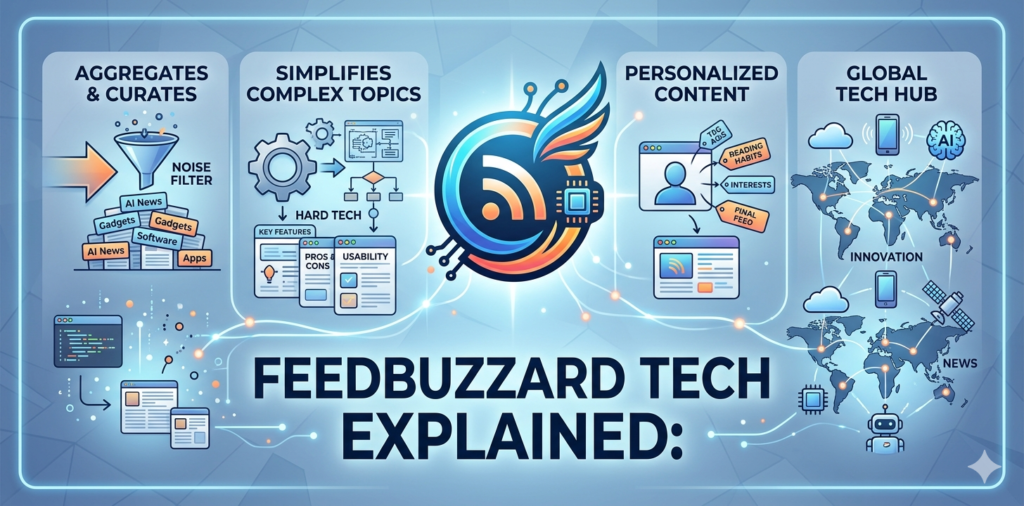
Feedbuzzard tech refers to a dual-purpose digital platform that combines a tech-focused content publishing site (Tech Feedbuzzard) with a feed-based digital advertising system (FeedBuzzard Advertising). One side feeds readers, the other side feeds advertisers, and together they form what’s becoming a fairly recognizable name in the “smart content + smart ads” space.
On the content side, the platform pulls together tech news, coding tutorials, gadget reviews, and trending pop-culture buzz into one feed. It’s not trying to be the next academic journal — it’s trying to be the place you check between meetings when you want a quick hit of “what’s new.” On the advertising side, it positions itself as a data-driven advertising solution, leaning heavily on audience targeting and real-time analytics rather than the old “blast it to everyone and hope” approach.
Core Content Categories on Tech Feedbuzzard
The content arm organizes its material into a handful of recurring categories, and honestly this structure is one of the smarter things about the platform — it stops the feed from feeling like a junk drawer.
| Category | What It Covers |
| Tech News & Updates | Product launches, AI breakthroughs, industry insights |
| Coding & Programming Guides | Python, JavaScript, HTML tutorials for beginners |
| Wearable Tech & Gadgets | Smartwatches, AR/VR, health trackers, real-world use cases |
| Pop Culture, Gaming & Multimedia | Anime, gaming trends, viral online content |
| Trending Buzz & Viral Topics | Global lifestyle trends and online zeitgeist content |
This mix is what makes the platform feel less like a niche blog and more like a content hub — readers come for the tech and stick around for the lighter stuff, or vice versa. Content Aggregation like this is becoming the norm rather than the exception in 2026, since most readers don’t want to bounce between five tabs to stay informed.
Content Quality: What to Expect
Quality across the site varies article to article, which is pretty typical for aggregator-style platforms. Some pieces are well-researched with clear explanations; others read more like quick summaries without much depth. So Tech Feedbuzzard works best as an introductory information source — a starting point, not the final word — particularly for anyone who needs citation-grade research or expert-level technical documentation.
You may also like to read Madison Alworth Wikipedia
Discover more about: RevolverTech Crew
Key Features That Power the Platform
AI-Powered Customization
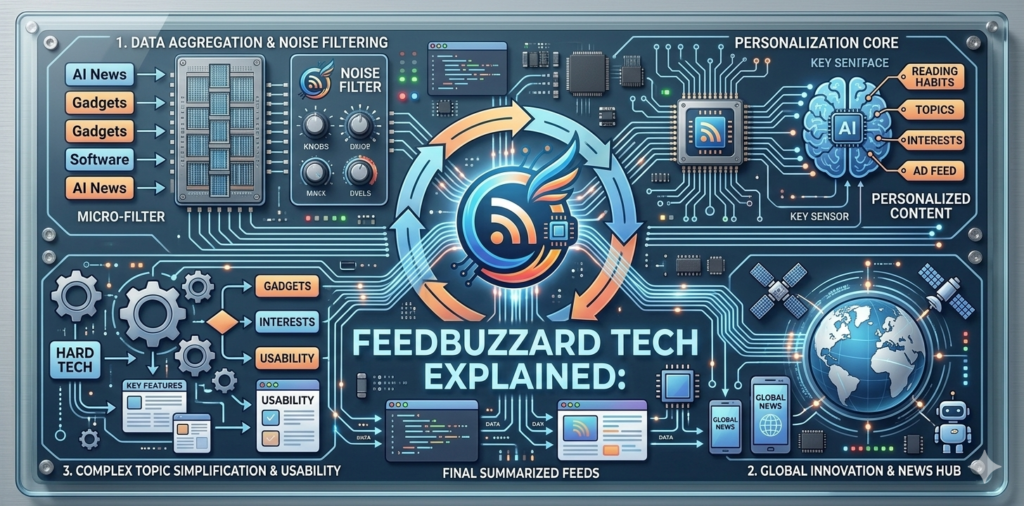
AI-Powered Customization shapes what each reader sees in their feed. The system studies behavioral patterns — what you click, how long you stay, what you skip — and uses that to push relevant content forward while burying the stuff you don’t care about. It’s the same basic logic that drives most modern recommendation engines, just applied to tech content instead of, say, video streaming.
Real-Time Analytics and Trending Updates
Both the content and advertising sides lean on real-time analytics. For readers, this means breaking news shows up fast instead of two days late. For advertisers, it means you’re not waiting around for a weekly report to know if a campaign is tanking — you can see clicks, conversions, and engagement basically as they happen, which honestly is the standard expectation now, not a bonus feature.
Multi-Source Content Aggregation
Rather than producing everything in-house, the platform draws from multiple outlets and stitches it into a single feed. This gives readers a broader view of a topic without the legwork, though it does mean the depth of any single article depends a lot on the original source quality.
FeedBuzzard Advertising: How It Actually Works
FeedBuzzard Advertising is a feed-based digital advertising approach that places promotional content directly inside content feeds, recommendation streams, and scrolling experiences — rather than interrupting users with traditional pop-ups or banner takeovers. The idea is simple: ads that feel native to the scroll get ignored less than ads that scream “I AM AN AD.”
Audience Targeting Drives Performance
Here’s the core relationship worth understanding: Audience Targeting → relies on behavioral and interest data → to improve ROAS. Instead of showing skateboard ads to someone who only ever clicks baking content, the system tries to match creative to actual interest signals. This is the single biggest lever advertisers pull when they’re trying to stop wasting budget on the wrong eyeballs.
You may also like to know about WallPostMedia com Review
You may also like to know about Apkek.org Review 2026
Metrics That Actually Matter
Not every metric deserves your attention. The platform (like most decent ad systems) really comes down to five numbers that tell you whether a campaign is working:
- Click-Through Rate (CTR) — are people even noticing the ad
- Conversion Rate — are clicks turning into actual results
- Cost Per Acquisition (CPA) — what each conversion is costing you
- Return on Ad Spend (ROAS) — the bottom-line profitability check
- Audience Engagement — likes, shares, comments, time spent
Everything else is kind of noise unless you’re running a very specific, very advanced campaign.
Flexible Pricing and Ad Formats
Advertisers aren’t locked into one billing structure — cost-per-click, cost-per-impression, whatever fits the campaign goal. And on the creative side, you’ve got video, native placements, and standard display banners all available, so the format can match the brand rather than forcing the brand to match the format.
Filling the Gaps: What Most Reviews Don’t Tell You
Most articles covering feedbuzzard tech stop at “it’s AI-powered and it has analytics.” That’s not really enough, though — especially if you’re trusting it with either your reading habits or your ad budget. Here’s the part that usually gets skipped.
Data Privacy and Algorithm Transparency
This is the big one. If a platform is studying your behavior to personalize a feed, you deserve to know what data it’s collecting and how long it keeps it. Most “AI-powered customization” write-ups conveniently leave this part out, and feedbuzzard-style platforms are no exception in the public-facing marketing.
A few questions worth asking before you treat any AI-driven feed (or ad targeting system) as fully trustworthy:
- Does the platform disclose what behavioral data it collects (clicks, time-on-page, device info)?
- Is there an opt-out option for personalized targeting, or is it on by default with no toggle?
- Are third-party data brokers involved in building audience profiles for advertisers?
- Is there a published privacy policy that actually explains retention periods, not just legal boilerplate?
Transparency here isn’t optional anymore — under frameworks like GDPR and various US state privacy laws, platforms collecting behavioral data for personalization or ad targeting are expected to disclose it clearly. If a site’s privacy documentation is vague or buried, that’s a red flag worth noting before you lean on its AI features too heavily, whether you’re a reader or an advertiser.
Quantified Performance Benchmarks
The second gap is numbers. A lot of feed-based advertising content talks in vibes — “engagement shot through the roof,” “results were insane” — without ever putting a real figure next to the claim. That’s not super useful if you’re trying to budget a campaign.
For context, here’s roughly where feed-based and native advertising tends to land industry-wide, based on commonly cited digital marketing benchmarks:
| Metric | Typical Industry Range (Feed/Native Ads) |
| Average CTR | 0.5% – 1.2% |
| Average Conversion Rate | 2% – 5% |
| Average CPA | Varies heavily by industry; often $20–$80 for SaaS/tech |
| Native Ad Engagement Lift vs. Display | Often cited as notably higher engagement than standard banner ads |
These numbers move around a lot depending on niche, audience size, and creative quality, so treat them as a general compass rather than a guarantee. But having some benchmark beats going in blind, and it’s a step most competitor content on this topic skips entirely.
Advantages of Using Feedbuzzard Tech
For readers and advertisers alike, there’s a real list of reasons people keep coming back:
- Personalized feeds that cut down on irrelevant scrolling
- Beginner-friendly explanations for technical or coding topics
- Real-time updates so you’re not finding out about news three days late
- Flexible ad formats and pricing for businesses of every size
- Clean, low-clutter interface that doesn’t fight you for attention
Who Should Actually Use It
| User Type | Good Fit? | Why |
| Casual tech readers | Yes | Quick, digestible overviews |
| Beginner developers | Yes | Step-by-step coding guides |
| Small business advertisers | Yes | Affordable, scalable ad tools |
| Enterprise researchers | Not ideal | Lacks depth for critical decisions |
| Developers needing technical docs | Not ideal | Content depth varies too much |
Getting Started With FeedBuzzard Advertising
If you’re testing the advertising side, the process generally follows a familiar pattern:
- Set up your account with basic business details.
- Define clear campaign objectives — brand awareness, leads, sales, app installs, whatever fits.
- Configure audience targeting based on interests, behavior, and demographics.
- Build and launch creative, then let real-time analytics guide your optimization.
The smartest advertisers don’t just set it and walk away, though. Optimization → requires continuous testing → of headlines, visuals, and placements, and even small CTR improvements compound into real ROAS gains over a few months.
Common Mistakes to Avoid
A handful of mistakes show up again and again with feed-based campaigns, and they’re avoidable once you know to watch for them:
- Targeting an audience that’s way too broad
- Scaling ad spend before testing creatives properly
- Ignoring mobile optimization (a huge chunk of feed traffic is mobile)
- Treating clicks as success instead of actual conversions
Where Feedbuzzard Tech Is Headed
The platform isn’t standing still, and that’s worth a quick mention before wrapping up. Expect deeper AI-driven personalization on the content side, plus broader sourcing from international tech communities as the feed tries to cover more ground than just US-centric news. On the advertising side, the trend line points toward even tighter integration with social platforms, so managing campaigns across multiple channels feels less like juggling and more like one dashboard doing the heavy lifting.
There’s also a push toward more interactive, community-driven features — think comment threads, Q&A style discussions, maybe even reader polls tied to trending stories. If that pans out, feedbuzzard tech could shift from being a one-way content feed into something closer to a genuine knowledge hub where people actually talk back, not just scroll past.
None of this is locked in stone, obviously, since platforms evolve based on what users and advertisers actually respond to. But the direction is pretty clear: smarter personalization, tighter privacy expectations (whether the platform likes it or not), and ad tools that keep chasing better ROAS for businesses of every size.
Final Verdict
So, is feedbuzzard tech worth your time or your budget? For readers chasing quick, digestible tech updates, it’s a solid daily-browse option — just don’t treat it as your only source for anything high-stakes. For advertisers, the feed-based model and real-time analytics genuinely do help cut wasted spend, provided you go in with clear targeting and realistic benchmark expectations rather than just hoping the algorithm figures it out for you.
Frequently Asked Questions
Q: Is feedbuzzard tech free to use for readers? A: Yes, the content platform is accessible without payment or account creation for general browsing. Advertising services, on the other hand, operate on flexible paid pricing models like cost-per-click or cost-per-impression depending on campaign needs.
Q: How does feedbuzzard tech protect user data? A: Specific data retention and privacy practices should always be checked directly against the platform’s published privacy policy. As with any AI-personalized platform, users should confirm opt-out options exist before assuming full data transparency.
Q: What’s the difference between Tech Feedbuzzard and FeedBuzzard Advertising? A: Tech Feedbuzzard is the content publishing side covering news, tutorials, and trends. FeedBuzzard Advertising is the separate feed-based ad platform helping businesses target audiences and track campaign performance through real-time analytics.
Q: Can small businesses realistically compete on FeedBuzzard Advertising? A: Yes. The platform’s flexible pricing and scalable targeting tools are specifically built to let smaller budgets compete, though results still depend heavily on creative quality and proper audience targeting setup.